
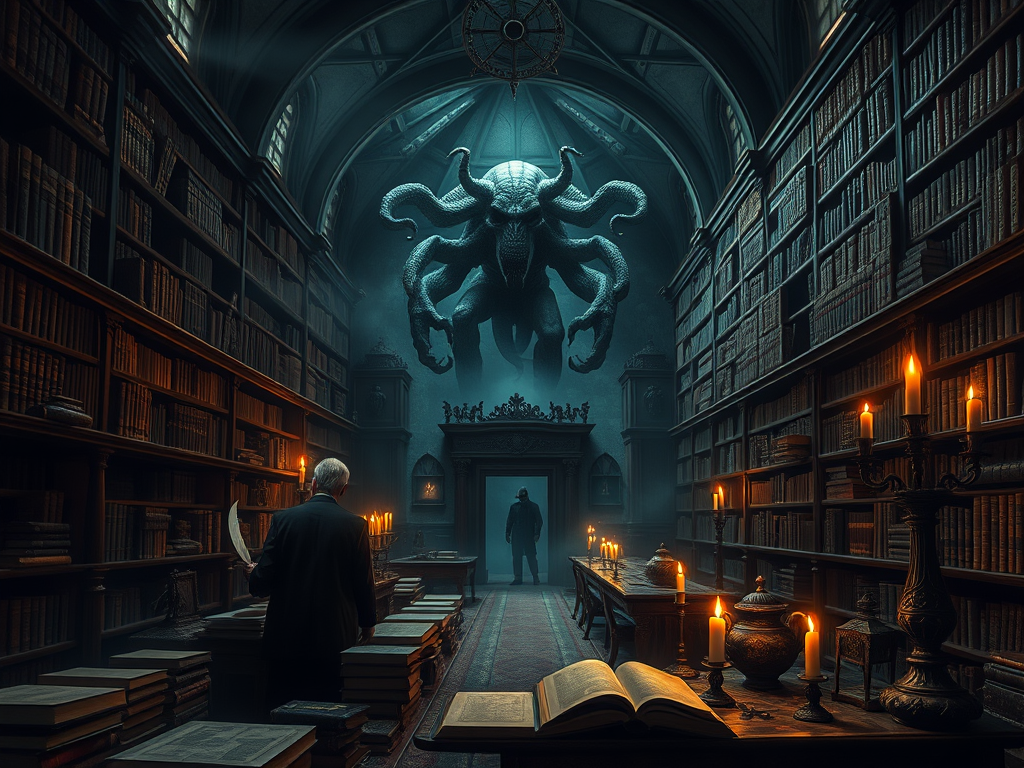
The Forgotten Stories Behind Lovecraft’s Cthulhu
Let me tell you a secret about Cthulhu one of literature’s most terrifying monsters. The tentacled, winged behemoth known as Cthulhu (whose name we’ve all struggled to pronounce). It did not simply spring, fully formed, from the nightmare-fueled mind of H.P. Lovecraft. No, great monsters, like great ideas, have ancestors. They have a family tree, a lineage of lesser-known horrors that paved the way.
Think of it like this: if Cthulhu is the fearsome, world-shaking grandson, then today we’re going to meet his grandparents. These are the authors and the books that sat on Lovecraft’s own shelf. They seeped into his imagination and provided the raw, philosophical clay from which he would sculpt his cosmic mythology.
So, pull up a chair. We are going on a literary archaeological dig. We are going to uncover the forgotten works that led the most famous monster in weird fiction, Cthulhu.
The comfortable, human-centric world view of the Victorian era was crumbling under the weight of new science.
Charles Darwin had shown that humanity was not a special creation. It was but an animal that had evolved through a brutal, mindless process. Astronomers like Percival Lowell were mapping the canals of Mars. That suggested a universe teeming with life, while also revealing the terrifying vastness and emptiness of space. Physics was introducing concepts so strange they defied common sense.
This was the fertile ground for Cosmic Horror: the idea that humanity is not just insignificant, but utterly helpless. Faced with a vast, uncaring, and monstrous universe. Lovecraft was the perfect prophet for this new fear, but he needed a language to express it. He found it in the weird tales of the late 19th and early 20th centuries.
The Grandfather of Awe: Lord Dunsany and the Sense of Immensity
If you want to understand where Lovecraft got his sense of cosmic scale. There is nowhere better to start than with an Irish aristocrat called Edward Plunkett. Who was the 18th Baron of Dunsany, or simply, Lord Dunsany.
Dunsany did not write about monsters with tentacles. He wrote about gods, time, and forgotten realms. His prose had the wistful elegance of a bard singing about a lost golden age. His work, collections like “The Gods of Pegāna” or “A Dreamer’s Tales”, is not horrific in the traditional sense. It is melancholic and awe-inspiring.
What Dunsany Gave Lovecraft‘s Cthulhu
Invented Mythologies. Dunsany did not just set stories in another world; he built its entire pantheon of gods from scratch. They had names like Mana-Yood-Sushai and Mung. Lovecraft saw the power in this. Instead of rehashing Greek or Norse myths, he could create his own. Where Dunsany’s were poetic and tragic, Lovecraft’s would be predatory and insane.
The “Weird” as Atmosphere. Dunsany’s prose is hypnotic. He uses rhythm and repetition to create a dreamlike, ancient feeling. Lovecraft adopted this stylistic flourish. Learning that the “feeling” of a story, the sense of immense age and decay, was as important as its plot. When you read a Lovecraftian phrase like “the great, old ones,” you are hearing the echo of Dunsany’s “the olden gods.”
Dunsany taught Lovecraft how to build a stage big enough for a god to appear on. He provided the sense of immensity. But immensity alone isn’t scary. For that, we need a touch of the perverse.
The Uncle of the Macabre: Arthur Machen and the Horror of the Familiar
While Dunsany dealt with cosmic spaces, the Welsh author Arthur Machen found horror in the ancient soil of the British countryside. Machen’s great theme was that the old, pagan world, the world of fairies, nymphs, and primal spirits, never truly left. It lurks just behind the thin veneer of our modern civilization, waiting to break through.
His most famous story, “The Great God Pan”, is arguably the single most important direct influence on the Cthulhu Mythos.
What Machen Gave Lovecraft and Cthulhu
The “Cosmic” Revealed on Earth. In “The Great God Pan”, a scientific experiment unlocks a character’s perception. It allows her to see the horrific, primal reality that underlies our own. The entity she encounters is not a ghost or a vampire; it is a primal force of nature. It is so alien that its mere presence drives people mad. This is the core of Lovecraft’s concept of “non-Euclidean geometry” and beings whose true form shatters the human mind.
The “Little People”. In his story “The Novel of the Black Seal”, Machen introduces the idea of a pre-human, monstrous race that still lives in the remote hills of Wales. They are small, vile, and worship unspeakable things. This is the clear blueprint for Lovecraft’s Mi-Go, the Fungi from Yoggoth, and especially his creepy, degenerate race, the Deep Ones. They interbreed with humans in “The Shadow Over Innsmouth”. Machen gave Lovecraft the model for the monstrous races that share our world.
The Power of Suggestion. Machen was a master of leaving the worst horrors to the reader’s imagination. The “Black Seal” of his story is never fully described; the horror of Pan is only glimpsed. Lovecraft learned this art of implication. We never get a full, clear, director’s-cut view of Cthulhu. We get fragments, a “mountain walking or stumbling,” a head “of an octopus with feelers.” The rest, the truly terrifying part, is painted by our own minds.
So now we have a vast, ancient stage (from Dunsany) and a blueprint for earthly, mind-shattering horrors (from Machen). But we’re still missing one crucial ingredient: the philosophy.
The Architect of Alienation: Algernon Blackwood and the Sentient Universe
Algernon Blackwood was a mystic and an outdoorsman. His stories pulse with the idea that Nature (with a capital ‘N’) is not just beautiful, but alive, conscious. It is also utterly indifferent to us.
His masterpiece, “The Willows”, is about two campers on a Danube island who come to realize that the swirling willow thickets around them are not just plants. They are the physical manifestation of vast, conscious, and hostile forces from another dimension.
What Blackwood Gave Lovecraft.
An actively hostile cosmos. Where Dunsany’s cosmos was melancholy and Machen’s was lurking, Blackwood’s was actively, intelligently malevolent. The entities in “The Willows” are not just there. They are aware of the human interlopers and they mean them harm. This is a key evolution towards the Lovecraftian universe. Where the Great Old Ones are not just sleeping; they are dreaming of a time when they will rule again. They are utterly hostile to human life.
Horror Through Landscape. Blackwood was a genius at making the environment itself the monster. The wind, the sand, the shape of the willows. They all become terrifying. Lovecraft took this to heart. The nightmare architecture of R’lyeh. Coupled with the oppressive decay of Innsmouth. The dizzying geometry of the alien city in “At the Mountains of Madness”. All are direct descendants of Blackwood’s sentient, menacing landscapes.
Indescribable Entities Blackwood’s ‘Others’ in “The Willows” are formless, and vast. They can only be perceived by their effects on the material world. This is precisely how Lovecraft describes his most powerful beings, like Azathoth, the “blind, idiot god” at the center of chaos. They are forces, not figures.
Weaving the Threads: How Lovecraft Built His Mythos
Imagine Lovecraft in his Providence library, surrounded by the works of these masters. From Dunsany, he takes the grand, mythological framework and the sonorous prose. And then from Machen, he takes the concept of ancient, terrestrial races and the horror of the unseen. From Blackwood, he takes the philosophy of a sentient, hostile universe and the technique of a menacing landscape.
He weaves these threads together, but he adds his own, unique, 20th-century spin: scientific materialism. For Lovecraft, the ‘gods’ were not supernatural. They were extraterrestrial or trans-dimensional beings. They were subject to laws of science far beyond our comprehension. This is his genius. He took the eerie, folkloric horror of Machen and the mystical awe of Blackwood and recast it in the language of astronomy, biology, and quantum physics.
Cthulhu is not a demon from hell; he is a high priest from the stars. A biological entity with a cellular structure allowing him to regenerate. He is trapped in a city that exists in a non-Euclidean space. He is the perfect fusion of his literary ancestors and the new, terrifying scientific rationalism.
Your Invitation to the Library
The wonderful thing about this literary genealogy is that you can explore it for yourself. These ‘ancestral’ books are not lost to time. They are, for the most part, available in the public domain. You can read the very stories that fired Lovecraft’s imagination.
Lord Dunsany’s “The Gods of Pegāna” is a short, beautiful, and strange collection of prose poems that feels like reading a sacred text from a world that never was.
Arthur Machen’s “The Great God Pan” is a chilling, decadent, and genuinely disturbing story that holds up remarkably well. You will see the DNA of a dozen Lovecraft tales within its pages.
Algernon Blackwood’s “The Willows” remains a masterclass in atmospheric horror. It’s a slow burn that gets under your skin and changes the way you look at a windy day.
By reading them, you do more than just understand a literary influence. You complete the circle. You see that even the most unique and terrifying visions are part of a conversation. A conversation across time, between writers building on the fears of those who came before them.
So the next time you see an image of that famous, tentacled visage, remember his family. Remember the poetic grandeur of Dunsany, the earthy perversion of Machen, and the sentient, howling terror of Blackwood. For in their pages, the monster was truly born.
Explore my expanding library of weird and wonderful books.
Yours in literary discovery,
Pete
Want a free book?
Discover Gothic Fiction’s First Vampire
Before Dracula, there was Lord Ruthven. John Polidori’s The Vampyre (1819) created the aristocratic undead villain that would haunt literature for centuries to come.
Get your free Pete Sumner Edition. Complete with scholarly essays exploring the scandalous Byron connection, the birth of vampire fiction, and Regency society’s darkest anxieties.
Click Here and start reading in minutes.
